
Young Children do not listen to their parents- Understanding Oppositional Defiant Disorder

A young lad  or lass in his or her teens  need to be paying attention to  the school curriculum and playing with the mates but instead if a child of this age become a problem for the family and the school , there is bound to be a cause and consternation amongst the family, teachers and the  well wishers of the child and the family.

Argument between mother and child

We have recently   been getting some   cases   of   young children behaving oddly in the families . The young ones  defy  their parents even for small errands .   They insist   on not going to schools . These children  refuse to listen to their parents. Some of them  go even to the extent of fighting   back with  their parents.

The parents have to understand that  children   usually are    defiant .They like to  oppose their parents  for many reasons. Obedience may not always be expected too.  We all will like to have independent thinking , self decision making children if the  decisions made by them meet our expectations.   During their  normal   growth and development  ,   individualism of human nature  does exert itself at times  when oppositional behavior  against the order and the expected  gets  expressed even by the young.

The  young children  want to grow up and their   desire to gain freedom  from control   gets  intense, around the ages of two and three,  and again  in early adolescent   years .

For  any parent however an uncooperative, disobedient   and aggressively hostile  behavior  of their  ward  becomes a serious issue when it is frequently ,  fiercely and arrogantly  expressed by the child.

Opposition of any kind  by the child becomes glaringly visible  when  it is  compared with other children’s    visible  obedient and docile  behavior .

This kind of  defiance and disobedience  gets very strainful  and stressful    for  the parents and other members of the    family.  It affects    the academic life  of the child in addition to being counted as an unsocial child within and outside the family circles .

Closing ears to the parents

Looking for the  the signs of  Oppositional  Defiant Disorder :  It’s not easy  for any parent to notice   differentiation   between normal defiance and the  oppositional defiant disorder (ODD) from age related  normal defiant  behavior by their children  . Symptoms of the disorder start appearing , in noticeable happenings on various occasions.

Child and parental conflict related   problems   are common in  families.

Families have various levels of tolerance for the opposition by their children . In some, a disgruntlement to  the rules produces major stress for the parents , while in more friendly , social and  tolerant families , opposition by children and occurrences of bad behaviors  by the kids  are largely overlooked till such times as  they cause relationship  problems .

In children  affected  with ODD,  a  systematic pattern of , anger,  aggression and the uncooperative, defiant, and aggressive  behavior toward authority can be seen. Such opposition by the young ones  regularly hampers  the  day to day functioning within the family . The children suffering get flayed tempers at times. These  children become hot headed and short tempered.

They  argue with adults. They take pleasure in fighting back against  adult rules.They refuse even minor  adult requests. They look for opportunities to   deliberately annoy others.

The same defiance continues – at home, in school, in the neighborhood .

Such behavior is not necessarily the  result of a conflict with a particular parent or teacher.

They begin with holding  others responsible for their mistakes.They   become grumbling kind and they often behave  touchy, arrogant , resentful, spiteful and  vindictive. Some children engage in mild physical aggression and fight back physically too . Their language   becomes  aggressive, abusive and  obscene. A kind of  power struggle within the family  begins  with these children.  

Their  struggle may be noticed in terms of food for choice, clothes to wear or simply in selecting a place to sit too.  During infancy  oppositional episodes must have occurred at the time of their  feeding,  eating, toilet training, and sleeping  etc. , but went unnoticed because of motherly love and affection . Children  with ODD regularly insist on postponing the work in home and at school and  they find strange reasons to  procrastinate.

They  ignore parental directions and their teachers orders. They would often   pretend  to forget or fail to hear . They are often referred to for memory exercises but we have to understand  that it is not the memory or hearing problem but the problem relates to   obeying what was expected of them.

As the child grows up the issues such as  keeping the room neat,  taking baths, doing home work on time , not watching television for longer times, not interrupting  while elders are talking or talking back, crop up.

In all such small    small quarrels and fights , winning becomes the most important aspect of their  struggle. At times a child with ODD will deliberately forego and rather lose  cherished privileges, in order to prove a point and win  the argument. The child will   exhibit .continuous opposition within the home environment. He or she will act completely  resistant and uncooperative  in the class room . On a serious side   the child continues with his or her defiance towards the established  authority . The child may not be in a position to understand the  difficulties or even get an inkling of his or her being in the wrong.

Such children as said earlier look for the reasons of their  troubles in others   behavior and in the other circumstances. external circumstances. There is always an inherent scant respect for the   the rules and discipline.  The child enjoys  challenging anyone who exhibits some kind of authority.

How can we help youAt Family Therapy India ,our special program for managing Oppositional Defiance Disorder  is supported to help children and adults to overcome the symptoms associated with ODD by our regular daily counseling sessions/mental exercises/ preksha meditation and Kayotsarg. Hundreds have benefited, it is your /your child’s turn now.  Call 09179383554 or email: mansikpramarsh@gmail.com.

Family is everything

Understanding the Real Causes Behind Oppositional Behaviours in Adolescents

Note: The names and stories in this article are fictional and used to illustrate common scenarios faced by adolescents.

Joseph, a twelve-year-old boy, never quite understood why he was constantly at odds with those around him. Whenever he tried to express himself at home or school, his words were often misinterpreted as defiance. His father would rebuke him, and his mother would end up in tears, often blaming Joseph for the conflict. At school, he was labeled the troublemaker, isolated by teachers and peers alike.

Jatin, a thirteen-year-old, faced a similar fate. His teacher singled him out as the class disruptor, forcing him to sit away from his classmates, amplifying his feelings of embarrassment and rejection. Every time noise erupted in the classroom, Jatin was the first to be blamed, even when the real culprits were other students. Despite recognising his innocence later, the teacher rarely corrected the misunderstanding.

Swara’s parents were equally puzzled. Their once calm daughter had begun shouting back at them and her teachers, behavior they couldn’t comprehend. They viewed it as sulking and brought her to therapy, hoping for a quick fix.

Photo by Stephen Andrews on Pexels.com

These cases are not isolated. Many children and adolescents, like Joseph, Jatin, and Swara, are often labeled by parents and teachers as defiant, difficult, or problematic. They are frequently referred to psychologists or psychiatrists for behavior correction and treatment for Oppositional Defiant Disorder (ODD), ADHD, or similar issues. Concerns about aggressive outbursts, disrespect, truancy, self-harm threats, and even suicide attempts often drive parents to seek professional help. However, what often goes unnoticed is the underlying stress, trauma, and unhealthy family dynamics that contribute to these outward behaviors.

Teachers typically report uncooperative behavior to parents, who, in turn, resort to punishments or admonishments when corrective efforts fail. When these measures prove ineffective, they turn to mental health professionals with one primary expectation: “Just fix my kid.” Unfortunately, this approach overlooks the crucial role that parental involvement and a supportive, positive environment at school can play in managing and improving these behaviors.

Therapy alone is often not enough. Adolescents with ADHD, Dissocial Behavior, or Adjustment Disorder are likely to regress if they return to a negative or unsupportive environment at home or school. Without addressing the root causes and making holistic changes, relapse is almost inevitable.

In Joseph’s case, a few changes at school, combined with the support of an understanding teacher, led to significant improvement. He went from being labeled a troublemaker to becoming a favorite student among his teachers. Similarly, Swara’s parents became actively involved in her therapy, learning to adjust their expectations and create a healthier family environment. As a result, Swara became more tolerant and communicative, leading to a harmonious household.

Photo by Alexander Grey on Pexels.com

We’ve observed that a comprehensive approach involving the entire family, as well as collaboration with school teachers, is the most effective way to treat conditions like ODD, ADD, ADHD, and Dissocial Disorder. At Family Therapy India and Alka Mansik Pramarsh Foundation, we advocate for a top-down approach that includes active participation from both parents and teachers. This holistic method has proven to bring about positive, lasting changes in the behavior and emotional well-being of children and adolescents without resorting to medication.

It’s important to recognize that behavioral challenges in adolescents are rarely about defiance alone. They are often expressions of deeper struggles that require understanding, compassion, and a collective effort from families, schools, and therapists to create a nurturing environment for these young individuals to thrive.

Helping your little champ build it up

Setting your kid up for success

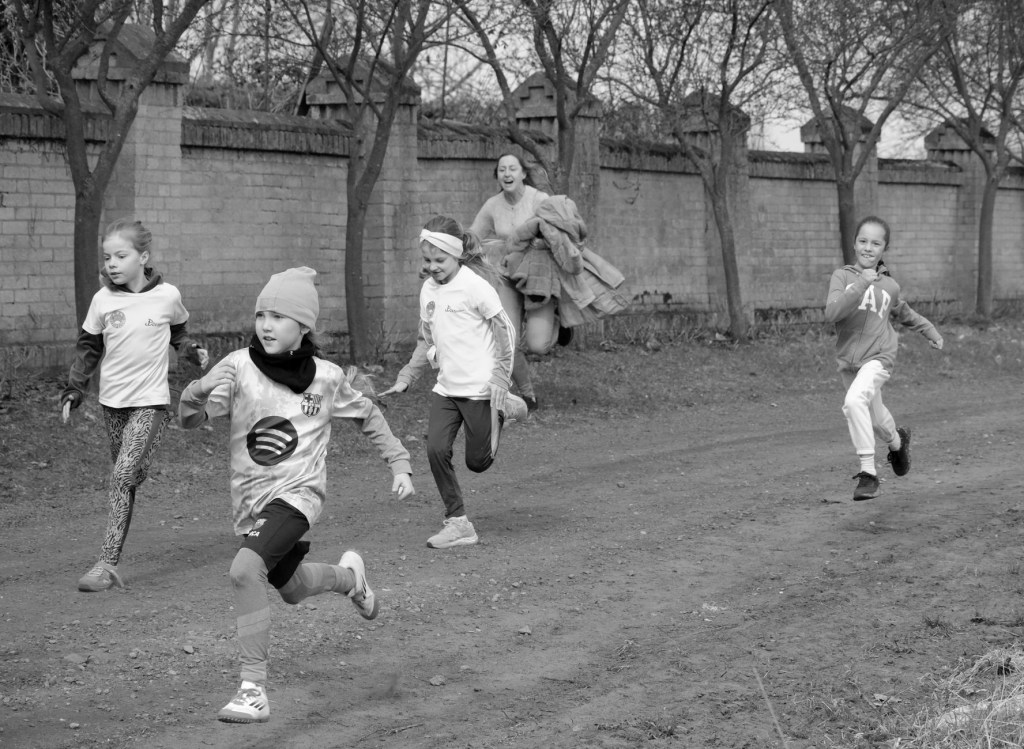
In a race for tiny tots a mother is encouraging her child to run and finish almost half a mile track .The pride on her face and her child lights up flashing smiles all around establishing a bond of trust and confidence in both of them.

A mother running along her child in a race.

Similarly another mother beams with pride when her daughter walks upto the stage to receive a certificate of excellence in her school declamation contest .

Such a bond between the parent and the child makes life easier for the child . A mother is always there when a child is stuck up and doesn’t know “How to handle the situation”.

A mother gets stressed and suffers equally when she finds her child struggling .She can feel the pangs as she looks at her child suffering. A mother can sense her borns anxiety due to natural bonding and empathy .

She wishes she could help her child when her born is struggling, She feels for her child and takes the task over from child . Most of the mothers do it .

However it can also mean curbing a child’s sense of freedom if a mother takes on everything in her hand .It is not necessary for a mother to make her child dependent on her for everything.

A mother’s support ,training and encouragement is an absolute necessity to help her children learn the first basics of human communication and interaction . There are small, steady ways to support them without feeling like a mother has to fix everything. 

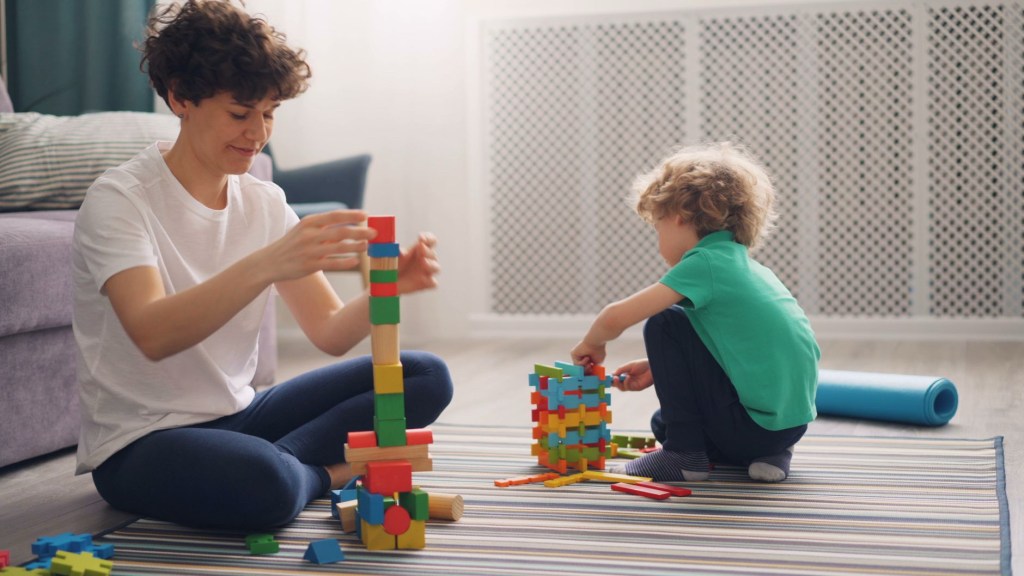
Building towers for her little champ.

A mother lives through the urge to protect her little one when she watches her child learning the small steps — and her heart runs faster while reaching out to protect and help the little one .
But as the little one starts growing to exert and express a new sense of autonomy and identity ,it’s the time when the problem begins .

The mother realises her ward is growing when he or she adamantly declares “I’m not going to school today”, at the last minute when mother is anxious to drop him or her at the Montessori /school or at the bus stop when she wants the child to hurry up .So that she can herself get ready to leave for her work.

Mother and child doing homework together.

Or when the child doesn’t want to sit for doing the homework with mother but insists on doing different things .The mother’s anxiety reaches its peak when she notices her child avoiding the task on account of various issues .
At this stage every mother faces two basic emotions , “is my child doing fine? can I help the child more ?or Am I doing enough for his or her growth ?”.
If any of this feels familiar, you are not the only mother and certainly not alone. It is something that every mother faces every day and struggles .

A mother can help her child develop better confidence by not taking over every activity of the child but by being available on hand and encouraging the child to try all new activities and difficult things independently but being close around him just in case the child needs help.

Remember: You can make him learn things only if you keep check on your emotions while allowing him to practice everything in your presence .Stay close to the child without taking over the activity from the child .
Allow the child learn and think differently, and you will see everyday challenges building up skill and confidence in your child .

These little steps can help every mother and her child

1. Break the harder learning into smaller easier learnable steps.

2. Extend your support and Help without taking over.Let the child know you are there .

3. Praise the effort and assure the child he can do it .

4. Keep your calm when the child feels stressed and wait for him to restart it again .

5. Don’t push to bring him out of the feelings.

6. Do not unnecessary try to divert allow time to think for himself.

6. Let the child ask for help and not shy away . Intervention at the right time keeps the pressure away .

Remember that the growth happens over time and step by step .Both mother and child learn things together to make them happen .