Have you been very angry lately and find it difficult to control?

lady driverVeena a company general manager swerved her car swiftly from hitting the road divider on the highway on way back home from the office, as the driver of another car overtook without any warning or flashing the indicator. In a reflex action Veena lowered side window glass and threw expletives on the driver of the other car. She could see a lady driver in the other car too appearing to be in a hurry to reach home after the office . “It could have been the end of my life today”, thought Veena,who was in a hurry to reach home much before her husband would make it .

car-horn-honking-driving-law-warning-809642“Possibly the lady driving other car too has an enraged husband waiting at home . That’s why the lady appeared to be in a hurry or it is likely that she has a sick child waiting at home”, justified Veena to herself . She found the other car drivers behind her honking , who had been equally disturbed by her abrupt change of direction to the right of the road . She breathed a few more swearing as she eased her car on the road again. Such a scene has become quite common in almost all towns where people appear to be in a mad rush with the surge of anger seething under their breaths. Veena could cool anger by feeling empathy for lady driver of the other car. But how many of us can actually feel such an empathy for the one who has been the cause of our anger .

We seldom develop charitable opinion towards any one whom we feel has tried to hurt us or has been the cause of physical,emotional or mental harm to us.We would often first flare up and may be much later try to justify our anger towards the person. Veena could come out of angry stance much faster without causing any kind of damage to physical or emotional self as she had immediately associated the other person’s doing with more charitable view point. But for a minute let’s just think that Veena had responded instead with a rage and seething anger to the situation .In such an event she could have felt hypertension, anger, emotional hurt and a sense of insecurity of the road rage in her mind already occupied with many other issues of otherwise busy life at home and in her office. Veena’s open mindedness and her attitude of reflecting and then reacting actually saved her from many could have been negatives .

We have been talking of , “How to understand and handle depression” and also, “How to manage our emotions” .In order to do that we have to first learn that the word depression is not a situation of single event, it is in truth accumulation of many other events taking place in our psyche and physical self . The depression when analysed from such point of view reveals that, restlessness, irritation, anger, negative thinking, negative emotions, worry, melancholy ,feeling of isolation , lack of passion, absence of self worth and even absence of sympathy/empathy all put together become the manifestation of depression. Should we not then really focus on taking care of each of these components and rectify/control/ /or cure them individually /cumulatively to get rid of depression from our mind.

While talking of anger we realize that this particular mood is the most difficult one for all of us to manage and control.Even in anger the rage is the most damaging kind of reaction where the mind loses its power of reason and logic on account of its intransigence nature. The rage makes us most vulnerable to not only damage the perpetrator but also ourselves. Some of us might feel that if the perpetrator has damaged us then we must take it out on him and then we feel relieved . Well to each his own viewpoint but the fact remains that ,”anger is never without a reason but seldom a good one”.

But going back to Veena’s state of mind, her anger definitely arose from the sense of danger to her physical self and to that of her property(her car). But if she had not controlled herself , there would have been a chain reactions of her rage . Her foul mood would have persisted even after she had reached home would have found its victim in her children and her husband. Her emotional turmoil however soon died down as soon as she developed a more charitable and logical attitude towards the driver of other car.

The lesson learnt, “As far as possible whenever a situation for rage builds up pause for a second and logically analyse the situation. This itself will bring down the intensity of the anger and subsequent rising of the tempers”.

Savor-Every-Moment-Family-CheeseLet us analyse one more situation. Maharishi family has come out for a dinner with another family friend of theirs to a high class restaurant known for its elegant ambiance. As soon as the waiter had placed soup dishes on the table , Mrs Maharishi’s younger child insisted on serving the soup into her dish herself. The young baby could hardly handle the hot dish and she found herself spilling the soup all over on the table.

Mrs Maharishi burst out in anger and hit the baby hard on her back . The loud yelling of the baby startled a passing by waiter. The tray he was carrying had slipped out of his hands pouring the dish down on the customers sitting on the nearby table. Loud arguments followed in the restaurant . Eventually embarrassed Maharishi family walked out of the restaurant in a huff with their guest walking out without eating .

soup spillsMany a times it would so happen that the anger comes to us in a sequence of various events and by the time we realize what has happened we end up losing control of the situation completely .This anger as we saw in the restaurant begins with one small event later on building up on the subsequent emotional reactions of angry outbursts.We just saw that anger had been building up on the earlier anger and the entire atmosphere had been converted into the inflamed oven of angry moods in the restaurant. The anger that had been just started with a small event got so intense after it found its subsequent hijacking devoid of any reason or logic .When we are engrossed into the angry atmosphere we just lose our sense of being and get carried away. This kind of anger had been built up not by the threat to the physical self but to the perceptive respectability, and disciplined family image of the Maharishi family . Mrs Maharishi felt insulted by the behavior of her child in the presence of her guests .She had hit the child rather than at that time she should have been taking control of the situation and calmed down the child.

Lesson learnt :Do Not immediately flare up and react instantly, more so when you have others around you.Take cognisance of the situation, Breathe awhile and let the anger subside within you, . You can always reflect later .Otherwise always remember that anger builds up on anger and sends an uncontrolled rush of emotional upheaval throughout the body damaging all reason and cognitive guidance of the mental faculty .

Let’s reflect on how to calm down in such situations .One way to handle anger is to allow a deviation of the mind like in Veena’s case where she had thought of empathy for the person causing the anger. Such deviation allows the mind cool down and develop a power of understanding within itself . Such power is very helpful in calming the mind always.

But in the other situation like that of Maharishi family the right way would have been to divert the attention of everyone from the scene but the intensity of the anger had been very high and hence the cognitive capabilities had been hijacked for everyone. Should we really allow that. Think how a little scolding can work better as compared to the only way of losing control of the situation and the mind completely.

argu cplManoj and his wife had been having argument for over a week now over some trivial matter. His wife noticed that every time the argument had begun Manoj would simply slip out of the house and return much later after her temper had died down. She followed him in their next bout of angry expletives .Manoj had gone to the temple nearby and he sat amongst the bed of flowers in the green lawns of the temple. She sat next to him as he moved aside to offer her more space. All that was causing trouble in them had been forgotten .They both decided to come to the same place next time an argument would start among them.Manoj told her that he would always allow himself a cooling down period every time he lost his temper , by coming to the calm and serene garden. Such distraction really works wonders on the mind and makes it one with the atmosphere .

69306261-young-couple-strolling-in-garden

Lesson learnt : Move out to the place of your liking when you get angry. The place can be the garden nearby, a place of worship, a coffee shop, a favourite restaurant, a small drive around the corner .There you can reflect calmly on the atmosphere around rather than pursuing the train of anger from which you have just execused yourself .

Such actions appear very ridiculous in nature but they work very powerfully on our mind and bring down the rising temperatures in no time.

-Ramneek Kapoor – Family Therapist , Psychologist Counselor and Science of Living Expert  .

logo family therapyFamily Always Comes First

Worried woman sitting at a kitchen table with phone and papers

The Quiet Damage of Emotional Abuse

“I still don’t understand how he could control me so easily, like I was a puppet, and why I kept giving in every single time.” Tina said this much later, when she finally had the distance to see things clearly. At the time, she could feel something was wrong, but she did not have the words for it.

Eventually, she understood what it was.

Emotional abuse. 

Photo by RDNE Stock project on Pexels.com

You might think abuse should be obvious and easy to point out, but emotional abuse rarely works that way. It does not show up loudly, and it does not leave visible damage that others can see. Instead, it builds slowly and quietly, affecting how you think, how you feel, and how you see yourself.

You notice something feels off.
You feel drained after simple interactions.
You start questioning your own reactions.

And yet, you stay.

Over time, emotional abuse begins to weaken your sense of self in ways that are easy to miss at first. You may get blamed for things you did not do, while your emotions are dismissed as overreactions. Your version of events gets questioned so often that you begin doubting your own memory. At some point, your focus shifts, and instead of asking why this is happening, you start asking what is wrong with you.

That shift changes everything.

The person causing harm often does not look harmful to others, which makes your experience even harder to validate. They may come across as calm, reasonable, or even caring in public. When you try to speak up, you might hear that you are too sensitive or that you are creating problems. After a while, you start believing it.

You stop trusting yourself.
You stop explaining yourself.
You start staying quiet.

Emotional abuse is not limited to romantic relationships, and that is something people often overlook. It can exist between parents and children, friends, colleagues, or extended family members. Power usually plays a role, even if it is not obvious at first. One person slowly takes control, and the other adjusts just to avoid conflict.

You begin to shrink parts of yourself to keep things steady.

Certain patterns tend to repeat in these situations. You may experience subtle threats that create fear and keep you from speaking freely. Constant criticism can make you feel like nothing you do is enough, even when you are trying your best. Your opinions may get dismissed so often that you eventually stop expressing them, not because you agree, but because you feel exhausted.

You may also feel unwanted while still being expected to stay. That creates a confusing dynamic where you are present but not valued. Isolation can follow, where you slowly drift away from friends or family, sometimes due to guilt or pressure. As your world becomes smaller, your dependence on the same person increases.

Blame plays a strong role here as well. You may find yourself apologizing often, even when you are unsure what you did wrong. Over time, this creates a deeper belief that you are responsible for the situation. You may even start feeling sympathy for the person hurting you.

That is where it gets dangerous.

You begin to believe you deserve this.

If you are in a situation like this, start by being honest with yourself about how you feel in the relationship. Ask yourself if you feel safe, respected, and heard consistently. Notice if you are constantly second-guessing your thoughts or walking on edge around the other person.

Do you feel like yourself anymore?
Or are you adjusting just to avoid conflict?

Talking about your experience can help, even if others do not fully understand at first. Reaching out to a therapist or counselor can give you clarity and help you see patterns more objectively. Setting boundaries matters, but following through on them matters even more.

You do not need permission to protect your mental and emotional well-being.

And keep this clear in your mind as you move forward. Someone being perceived as good by others does not mean they are good for you. Your experience is valid, even if it is not visible to the outside world, and that distinction matters more than you think.

If you find yourself in a situation like this, reaching out for support can make a real difference. At Family Therapy India, you can speak with professionals who understand these patterns and can help you work through the challenges in your relationship in a healthier, more constructive way.

Phone/Whatsapp: +91-9179383554

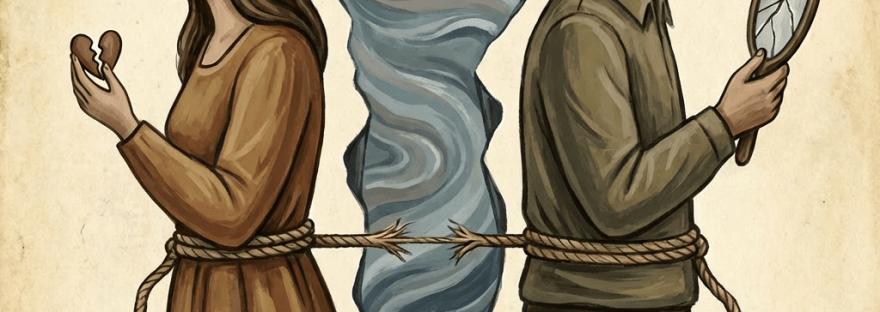
Man and woman back-to-back with a fraying rope and text reading "THE DISTANCE BETWEEN US".

Are You Losing Yourself in Your Relationship? Spot the Signs of Codependency

Manoj (name changed) started feeling drained just a few months into his marriage.

His wife, a doctor, had quit her job and slowly began depending on him for everything. Not just financially, but emotionally, mentally, even for the smallest day-to-day decisions.

She would call him repeatedly while he was at work. If he didn’t pick up, she expected him to drop everything and respond.

Now imagine being in his place.
How long before you start feeling suffocated?

Sasha (name changed) came in for therapy because of anxiety. But every time she was asked something, she looked at her partner to answer for her.

Even her own voice didn’t feel like hers anymore.

Here’s the thing.

Depending on someone you love? That’s normal.

But when that dependence starts taking over your ability to function on your own, it stops being healthy and starts becoming something else.

It turns into a kind of emotional addiction.

You start abandoning your own needs just to keep the other person okay.
Or you expect someone else to constantly regulate your emotions and decisions.

Either way, someone loses themselves.

Man and woman back-to-back with a fraying rope and text reading "THE DISTANCE BETWEEN US".

So what exactly is codependency?

It’s when one person relies heavily on another
or both people rely on each other

for emotional support, validation, decision-making, even self-worth.

And this doesn’t just show up in romantic relationships.

You’ll see it everywhere:

  • Parent and child
  • Friends
  • Coworkers
  • Partners
  • Even teacher-student dynamics

A parent-child version can get especially intense.

Some parents struggle to let their child grow, move out, or build an independent life.

And the child?
They often feel stuck between guilt and growth.

Is this just emotional support… or something deeper?

Humans are wired to depend on each other.

You don’t live life in isolation. You learn, adapt, and grow through people.

But pause and ask yourself this:

Can you function on your own?
Or does the idea of making decisions alone make you anxious?

Because when dependence starts interfering with your ability to think, decide, and act independently, it usually connects to deeper mental health struggles like:

  • Anxiety
  • Depression
  • Addiction
  • Low self-esteem
  • Chronic stress
  • Personality patterns like BPD or narcissism

Codependency in small amounts? Fine.

But when it starts replacing your sense of self, it chips away at your identity and your relationships.

Trust weakens.
Resentment builds.
And you start feeling stuck.

Where does codependency even come from?

Most of it traces back to childhood.

Not in an obvious way. But in subtle patterns you picked up early.

Think about this:

  • Did you grow up feeling judged or criticized often?
  • Did you feel ignored or emotionally unseen?
  • Did someone leave, creating a fear of abandonment?
  • Were your caregivers inconsistent, warm one day and distant the next?
  • Were your parents overly controlling?
  • Did you experience any form of trauma?
  • Did you grow up around untreated mental health issues?

When you grow up like this, you learn one thing fast:

Your needs are secondary.

And that belief quietly follows you into adult relationships.

How do you know if you’re codependent?

Look at your patterns honestly.

  • You struggle with self-worth
  • You constantly need validation
  • Saying “no” feels uncomfortable
  • You feel responsible for fixing other people
  • You chase perfection to feel accepted
  • You either try to control others or give them control over you

Now think about your relationships.

Do you:

  • Ask for permission for basic things?
  • Feel like you’re walking on eggshells?
  • Try to “fix” or rescue someone?
  • Take responsibility for their actions?
  • Sacrifice your comfort regularly?
  • Feel like you’ve lost who you are?

That’s what codependency starts to look like in real life.

A few situations that might hit close to home

  • A woman stays in an emotionally abusive relationship, hoping love will change her partner
  • A graduate turns down a dream opportunity just to stay close to a parent
  • An adult child moves back home and stops taking responsibility, while the parents enable it

None of these people are “weak.”

They’re stuck in patterns they learned long ago.

Can this be fixed?

Yes. But only if you’re willing to look at yourself honestly.

If ignored, codependency can deepen:

  • Anxiety
  • Depression
  • Emptiness
  • Loneliness

You might start feeling like you don’t even know who you are outside of your relationships.

That’s the real cost.

What actually helps?

Therapy plays a big role here.

  • CBT helps you break unhealthy thought patterns
  • Couples therapy improves communication and independence
  • Family therapy helps unpack long-standing dynamics

But beyond therapy, here’s something to sit with:

Can you be okay on your own?
Can you make decisions without needing reassurance?
Can you sit with discomfort without rushing to fix or please?

That’s where the real shift begins.

Codependency is learned. Which means it can be unlearned too.

And when that starts happening, your relationships stop feeling like survival…
and start feeling like choice.

The Role of Friendship in Physical and Mental Health

Friendship plays a measurable role in psychological and physiological well-being. Friendship shapes your internal stability more than most people admit.

It affects how you regulate stress, how you see yourself and how safe you feel in the world.

Studies consistently show that strong social bonds lower cortisol levels and reduce the risk of depression.

Chronic loneliness, by contrast, correlates with elevated inflammatory markers, higher cardiovascular risk, and increased likelihood of mood disorders. Social connection is not simply a preference. It functions as a protective factor.

Friendship also contributes to social health, defined as the ability to build, sustain, and navigate interpersonal relationships. Through friendship, individuals develop community, experience belonging, and buffer the effects of isolation.

Free friendship image“/ CC0 1.0

Friendship Within Other Relationships

Friendship is often viewed as distinct from family or romantic partnership. In practice, it frequently exists within those bonds.

When friendship is present in a family relationship or romantic partnership, it introduces mutual respect, emotional safety, and ease of communication. The presence of friendship strengthens relational stability and increases resilience during conflict.

Friendship may also develop among coworkers, neighbors, or shared-interest groups. In these contexts, repeated interaction and shared experience create the conditions for trust and familiarity.

Is It Problematic to Lack Close Friends?

The psychological benefits attributed to friendship stem from emotional safety, reciprocity, and trust. These qualities may also exist within family systems or romantic partnerships.

Periods without close friendships are common during major life transitions, including relocation, career changes, divorce, or parenthood. During such phases, time constraints and shifting priorities often limit relational maintenance.

Temporary absence of close friendships does not necessarily indicate social impairment. It may reflect environmental or developmental changes.

Indicators of Healthy and Unhealthy Friendships

Healthy friendships are characterized by:

  • Mutual care: Each person values the other beyond utility.
  • Genuine affinity: Enjoyment of each other’s company independent of obligation.
  • Psychological safety: The ability to express thoughts, emotions, and identity without fear of rejection or ridicule.

Unhealthy friendships may involve manipulation, imbalance, emotional exploitation, or subtle coercion. Emotional harm can occur in platonic relationships as well as romantic ones.

Friendship and Mental Health

Consistent social support contributes to:

  • Reduced stress reactivity
  • Greater self-esteem
  • Lower likelihood of harmful coping behaviors
  • Improved health behaviors
  • Increased sense of belonging

Belonging functions as a stabilizing force for identity and emotional regulation.

Discussing Mental Health Within Friendships

Effective mental health conversations include:

  • Honest self-disclosure to model openness
  • Active listening without premature problem-solving
  • Reducing pressure to appear consistently positive
  • Encouraging professional support when appropriate

Friendship provides emotional support. It does not replace clinical care.

Supporting a Friend Experiencing Mental Health Challenges

Mental health conditions may affect reliability, communication, and emotional availability. Clear communication about expectations and boundaries protects both individuals.

Questions such as the following can clarify support:

  • What type of support is most helpful right now?
  • What feels sustainable for both parties?

Healthy friendships balance empathy with realistic limits.

Final Reflection

Friendship is not measured by quantity or constant contact. Its value lies in emotional safety, reciprocity, and trust.

Across different stages of life, friendships evolve. Some deepen. Some shift. Some end. What remains consistent is the human need for connection that affirms identity and reduces isolation.

Investing in healthy friendships requires intention. It involves showing up consistently, communicating clearly, and respecting boundaries. It also requires discernment—recognizing when a relationship supports your well-being and when it does not.

Mental health does not exist in isolation from relationships. The quality of your connections influences how you cope with stress, process adversity, and experience belonging.

Evaluating your friendships with honesty can be an important step in protecting your psychological health. Consider which relationships feel mutually supportive, which feel imbalanced, and where communication could be strengthened.

Healthy friendships do not demand perfection. They require presence, care, and accountability.

Connection remains one of the most protective factors in mental well-being.

Navigating the Honeymoon Phase to Long-Term Love

During the early stages of dating, couples often experience a sense of excitement and anticipation that makes every interaction feel meaningful. They look forward to the next meeting, replay conversations in their heads, and feel emotionally charged by even the smallest gestures. Everything appears brighter and lighter, and partners often view each other through a romantic lens that highlights attraction, affection, and possibility. During this phase, love feels instinctive rather than intentional, and effort rarely feels like effort.

This honeymoon phase usually exists without the pressure of shared responsibility. Couples are focused on connection and discovery rather than coordination and compromise. Daily routines, long-term planning, and external expectations have not yet entered the picture in a significant way, which allows romance to stay front and center without much interference from real-life demands.

As relationships move forward, this dynamic naturally shifts.

Photo by Alina Kurson on Pexels.com

Being in a long-term relationship extends far beyond physical intimacy or emotional closeness. It slowly becomes about building a shared life, which brings with it a wide range of responsibilities that require cooperation, communication, and emotional maturity. Partners often find themselves adjusting to new family dynamics, learning how to function as a unit within larger social systems, and balancing personal goals with collective needs. Careers demand time and energy, household expenses need planning, chores require division, and family obligations begin to carry more weight. For many couples, this phase also includes raising children, participating in cultural or religious traditions, and supporting ageing parents or relatives, all while trying to preserve their bond with each other.

These responsibilities do not appear one at a time. They overlap, compete for attention, and often intensify during already stressful periods of life. What once felt simple can begin to feel layered and complex, and love starts to be tested not by a lack of feeling but by the pressure of daily realities.

Over time, couples who remain happy begin to recognize that communication matters more than chemistry alone. Romance no longer sustains itself automatically, and emotional connection requires conscious effort. Small disagreements about money, work stress, family expectations, or cultural differences may start to occur more frequently. When these issues remain unspoken or unresolved, they rarely disappear. Instead, they settle quietly beneath the surface and resurface later as frustration or emotional distance.

Resentment usually builds through silence rather than conflict.

There is also an emotional shift that many people experience but struggle to articulate. In the early stages of a relationship, individuals often present a curated version of themselves. They show patience more easily, overlook irritations, and manage their reactions carefully. Over time, as comfort increases, this performance fades and reality takes its place. Stress becomes visible, exhaustion shows up, and vulnerabilities come to the surface. Life events such as health concerns, financial uncertainty, or family pressure begin to affect the relationship in tangible ways.

At this stage, couples are no longer simply dating each other. They are sharing real life.

This transition can feel unsettling. People may start to believe that love is fading because it no longer feels light or effortless. They may compare the present to the past and question whether something has gone wrong. In most cases, nothing is broken. The relationship is simply moving from fantasy into stability, from intensity into endurance.

Long-term love demands a different set of skills. It requires listening even when energy is low, staying engaged during uncomfortable conversations, and choosing repair over withdrawal. Love becomes less about emotional highs and more about consistency, reliability, and presence.

Couples who sustain their connection over time are not those who avoid disagreement. They are those who learn how to disagree without damaging trust. They communicate without belittling each other, manage conflict without escalating it, and understand that emotional safety strengthens attraction rather than diminishing it. They remain curious about each other even after years together, recognizing that both partners will continue to change.

Maintaining love in a long-term relationship requires intention rather than assumption. Communication needs to be regular and honest, not only during moments of crisis. Misunderstandings should be approached as opportunities for growth rather than competitions to be won. Romance needs to be created deliberately through attention, presence, and small acts of care, especially when life feels busy or overwhelming. Sharing responsibility, whether emotional or practical, helps partners feel supported rather than burdened.

Couples who stay connected also make space for conversations beyond logistics. They talk about how they are coping, not just what needs to be done. They notice effort and acknowledge it, understanding that appreciation strengthens emotional bonds. They protect their relationship from external noise, including family opinions, societal expectations, and comparison with others. They allow each other room to grow, recognizing that neither partner will remain the same person over time.

During conflict, they choose kindness alongside honesty. They speak with respect even when emotions run high, knowing that how something is said matters as much as what is said.

Relationships rarely fail because romance disappears. They struggle when communication stops, when resentment replaces curiosity, and when partners stop choosing each other in everyday moments. The most meaningful question couples can ask themselves during difficult phases is whether they are leaning toward understanding or retreating into distance.

Long-term love is not something that sustains itself without care. It is a practice that requires patience, empathy, and shared responsibility. When two people commit to showing up for each other consistently, adjusting when needed, and growing side by side, love does not fade. It matures into something steadier, deeper, and more resilient, offering a sense of grounding that only time and commitment can create.