
Young Children do not listen to their parents- Understanding Oppositional Defiant Disorder

A young lad  or lass in his or her teens  need to be paying attention to  the school curriculum and playing with the mates but instead if a child of this age become a problem for the family and the school , there is bound to be a cause and consternation amongst the family, teachers and the  well wishers of the child and the family.

Argument between mother and child

We have recently   been getting some   cases   of   young children behaving oddly in the families . The young ones  defy  their parents even for small errands .   They insist   on not going to schools . These children  refuse to listen to their parents. Some of them  go even to the extent of fighting   back with  their parents.

The parents have to understand that  children   usually are    defiant .They like to  oppose their parents  for many reasons. Obedience may not always be expected too.  We all will like to have independent thinking , self decision making children if the  decisions made by them meet our expectations.   During their  normal   growth and development  ,   individualism of human nature  does exert itself at times  when oppositional behavior  against the order and the expected  gets  expressed even by the young.

The  young children  want to grow up and their   desire to gain freedom  from control   gets  intense, around the ages of two and three,  and again  in early adolescent   years .

For  any parent however an uncooperative, disobedient   and aggressively hostile  behavior  of their  ward  becomes a serious issue when it is frequently ,  fiercely and arrogantly  expressed by the child.

Opposition of any kind  by the child becomes glaringly visible  when  it is  compared with other children’s    visible  obedient and docile  behavior .

This kind of  defiance and disobedience  gets very strainful  and stressful    for  the parents and other members of the    family.  It affects    the academic life  of the child in addition to being counted as an unsocial child within and outside the family circles .

Closing ears to the parents

Looking for the  the signs of  Oppositional  Defiant Disorder :  It’s not easy  for any parent to notice   differentiation   between normal defiance and the  oppositional defiant disorder (ODD) from age related  normal defiant  behavior by their children  . Symptoms of the disorder start appearing , in noticeable happenings on various occasions.

Child and parental conflict related   problems   are common in  families.

Families have various levels of tolerance for the opposition by their children . In some, a disgruntlement to  the rules produces major stress for the parents , while in more friendly , social and  tolerant families , opposition by children and occurrences of bad behaviors  by the kids  are largely overlooked till such times as  they cause relationship  problems .

In children  affected  with ODD,  a  systematic pattern of , anger,  aggression and the uncooperative, defiant, and aggressive  behavior toward authority can be seen. Such opposition by the young ones  regularly hampers  the  day to day functioning within the family . The children suffering get flayed tempers at times. These  children become hot headed and short tempered.

They  argue with adults. They take pleasure in fighting back against  adult rules.They refuse even minor  adult requests. They look for opportunities to   deliberately annoy others.

The same defiance continues – at home, in school, in the neighborhood .

Such behavior is not necessarily the  result of a conflict with a particular parent or teacher.

They begin with holding  others responsible for their mistakes.They   become grumbling kind and they often behave  touchy, arrogant , resentful, spiteful and  vindictive. Some children engage in mild physical aggression and fight back physically too . Their language   becomes  aggressive, abusive and  obscene. A kind of  power struggle within the family  begins  with these children.  

Their  struggle may be noticed in terms of food for choice, clothes to wear or simply in selecting a place to sit too.  During infancy  oppositional episodes must have occurred at the time of their  feeding,  eating, toilet training, and sleeping  etc. , but went unnoticed because of motherly love and affection . Children  with ODD regularly insist on postponing the work in home and at school and  they find strange reasons to  procrastinate.

They  ignore parental directions and their teachers orders. They would often   pretend  to forget or fail to hear . They are often referred to for memory exercises but we have to understand  that it is not the memory or hearing problem but the problem relates to   obeying what was expected of them.

As the child grows up the issues such as  keeping the room neat,  taking baths, doing home work on time , not watching television for longer times, not interrupting  while elders are talking or talking back, crop up.

In all such small    small quarrels and fights , winning becomes the most important aspect of their  struggle. At times a child with ODD will deliberately forego and rather lose  cherished privileges, in order to prove a point and win  the argument. The child will   exhibit .continuous opposition within the home environment. He or she will act completely  resistant and uncooperative  in the class room . On a serious side   the child continues with his or her defiance towards the established  authority . The child may not be in a position to understand the  difficulties or even get an inkling of his or her being in the wrong.

Such children as said earlier look for the reasons of their  troubles in others   behavior and in the other circumstances. external circumstances. There is always an inherent scant respect for the   the rules and discipline.  The child enjoys  challenging anyone who exhibits some kind of authority.

How can we help youAt Family Therapy India ,our special program for managing Oppositional Defiance Disorder  is supported to help children and adults to overcome the symptoms associated with ODD by our regular daily counseling sessions/mental exercises/ preksha meditation and Kayotsarg. Hundreds have benefited, it is your /your child’s turn now.  Call 09179383554 or email: mansikpramarsh@gmail.com.

Family is everything

Helping your little champ build it up

Setting your kid up for success

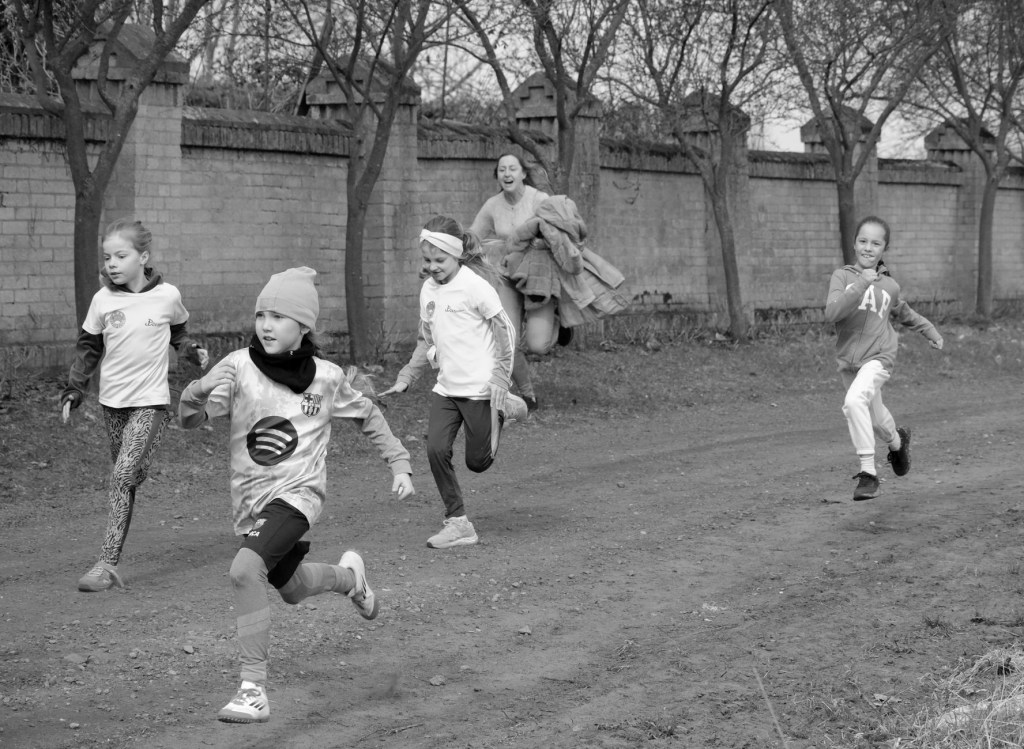
In a race for tiny tots a mother is encouraging her child to run and finish almost half a mile track .The pride on her face and her child lights up flashing smiles all around establishing a bond of trust and confidence in both of them.

A mother running along her child in a race.

Similarly another mother beams with pride when her daughter walks upto the stage to receive a certificate of excellence in her school declamation contest .

Such a bond between the parent and the child makes life easier for the child . A mother is always there when a child is stuck up and doesn’t know “How to handle the situation”.

A mother gets stressed and suffers equally when she finds her child struggling .She can feel the pangs as she looks at her child suffering. A mother can sense her borns anxiety due to natural bonding and empathy .

She wishes she could help her child when her born is struggling, She feels for her child and takes the task over from child . Most of the mothers do it .

However it can also mean curbing a child’s sense of freedom if a mother takes on everything in her hand .It is not necessary for a mother to make her child dependent on her for everything.

A mother’s support ,training and encouragement is an absolute necessity to help her children learn the first basics of human communication and interaction . There are small, steady ways to support them without feeling like a mother has to fix everything. 

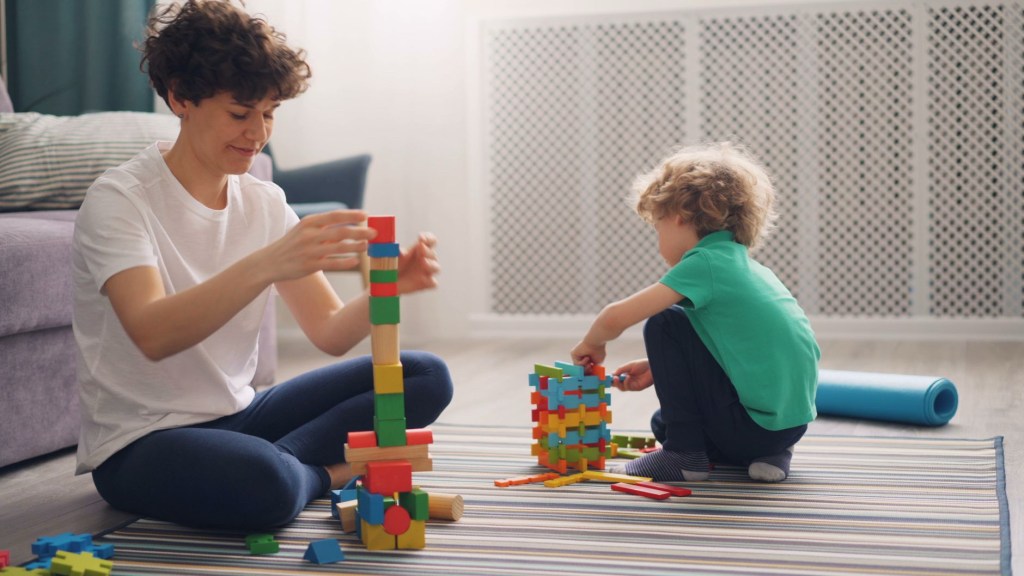
Building towers for her little champ.

A mother lives through the urge to protect her little one when she watches her child learning the small steps — and her heart runs faster while reaching out to protect and help the little one .
But as the little one starts growing to exert and express a new sense of autonomy and identity ,it’s the time when the problem begins .

The mother realises her ward is growing when he or she adamantly declares “I’m not going to school today”, at the last minute when mother is anxious to drop him or her at the Montessori /school or at the bus stop when she wants the child to hurry up .So that she can herself get ready to leave for her work.

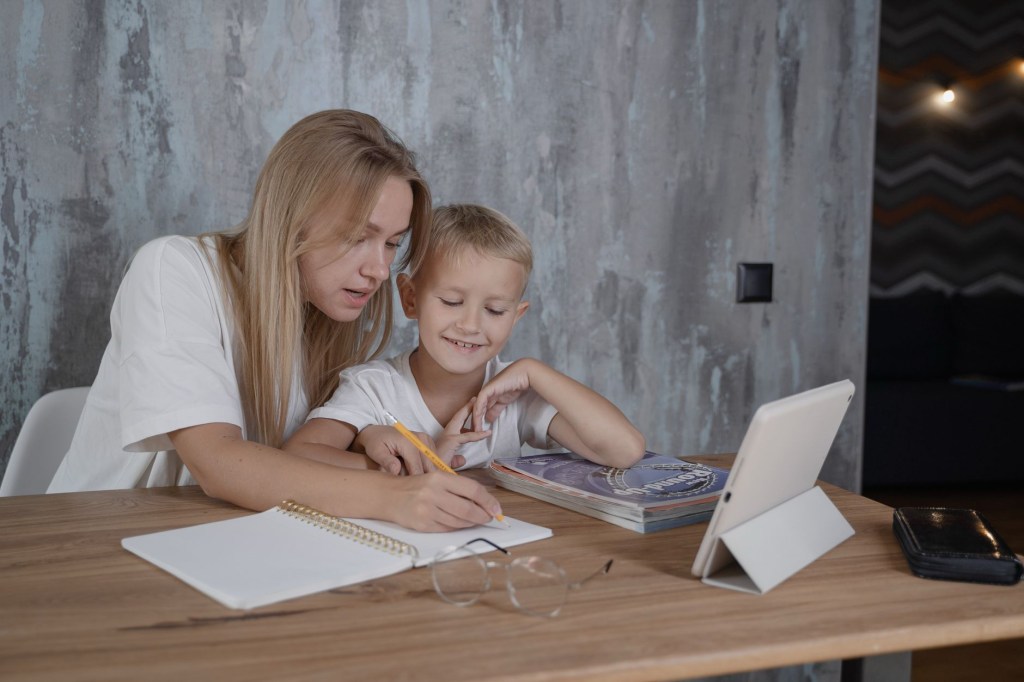
Mother and child doing homework together.

Or when the child doesn’t want to sit for doing the homework with mother but insists on doing different things .The mother’s anxiety reaches its peak when she notices her child avoiding the task on account of various issues .
At this stage every mother faces two basic emotions , “is my child doing fine? can I help the child more ?or Am I doing enough for his or her growth ?”.
If any of this feels familiar, you are not the only mother and certainly not alone. It is something that every mother faces every day and struggles .

A mother can help her child develop better confidence by not taking over every activity of the child but by being available on hand and encouraging the child to try all new activities and difficult things independently but being close around him just in case the child needs help.

Remember: You can make him learn things only if you keep check on your emotions while allowing him to practice everything in your presence .Stay close to the child without taking over the activity from the child .
Allow the child learn and think differently, and you will see everyday challenges building up skill and confidence in your child .

These little steps can help every mother and her child

1. Break the harder learning into smaller easier learnable steps.

2. Extend your support and Help without taking over.Let the child know you are there .

3. Praise the effort and assure the child he can do it .

4. Keep your calm when the child feels stressed and wait for him to restart it again .

5. Don’t push to bring him out of the feelings.

6. Do not unnecessary try to divert allow time to think for himself.

6. Let the child ask for help and not shy away . Intervention at the right time keeps the pressure away .

Remember that the growth happens over time and step by step .Both mother and child learn things together to make them happen .

How Do We Manage Anxiety in Children.

We often think that our children have better resilience to their anxiety and they become normal once we have either given them positive strokes,bought them a chocolate,a gift or diverted their attention by permitting them to play video games . But it needs to be understood that anxiety doesn’t happen to the kids like the way we experience it happening to us adults. Anxiety in children can trigger, in panic attacks,in their tantrums ,in their sudden rush of energy or it may occur in the untimely defiant behaviour.We as parents just push it aside by ascribing it to their misbehaving or being in the company of wrong friends .However children may react differently depending on the immediate situation ,past incidents or future anticipations.

As psychologists counselors and family therapists we have to deal with couples , parents and other family members of our clients who always appear to be suffering from anxiety, In most such cases their children too suffer from similar anxiety or otherwise children from families where there is a good coordination amongst parents struggle with anxiety too .

Some parents would pretend and hide their issues of anxiety and other concerns from their children . Even when kids are understanding the parents would try to act as if everything was fine .These parents would do everything they deem fit or within their reach to calm their wards and reset their nervous system through various practices of calming . Children can pick up anxiety from their parents through the verbal communication, through the body language of their parents,through their mood disorders or the kids themselves can react to any genreal event in the family and develop a full or partial panic attack.

We have seen many a parents fighting and undermining each other when they come to us. They fail to realise that when they behave so their children too suffer mental agony and a fear of being abandoned by either or both of their parents. Children feel abused when their parents fight .They feel cheated by their parents.Children want to live in a typical family life environment irrespective of the riches or poverty.Any thought of living without a parent causes them much mental pain and that triggers anxiety.To them, their family is their safety nest. Their family enables them to play, to study, to make friends .It helps them grow. It is the reason of their being here in the world. To them family is the only reality ,rest all is just make believe.Any iota of doubt on family’s continuity causes deep anxiety.

Parents should remember that their children would always pick up the stress and trauma that their parents experience and exhibit. The parents may think that their children are safe and that children have not been exposed to any kind of stress , physical,sexual, or emotional or personality abuse . They may believe that they are offering their children a great childhood compared to parents’ own childhood or other experiences that parents had to suffer. But actual truth is far from this .Children can become anxious for many reasons triggered by the parents obvious circumstances or not so obvious happenings within the family .Some of these reasons could be the actual and some could be as perceived by the children. To us adults many of those reasons might not be major , but to a child they become quite significant in triggering insecurities and anxiety thereof. Should the parents happen to be separated or divorced the self blaming mind of the children would always be devastated by the memories of the times when the family was together. They would not understand the sudden blow of isolation and the non availability of the parental umbrella .They struggle to be emotionally available to the single parent they now live with and at the same time add on a make believe relationship with the parent they have been separated from which they continue to believe was on their account.A two edged anxiety of this kind breaks them . It shreds the very fiber of their mental balance.

Children are often left heart broken if there happens to be a fight in their family.They tend to believe that all tension is on account of their being a cause of distress to their parents. Often they are left with a broken trust .They feel guilty with their self confidence devastated by the memories of parents shouting at each other.They are afraid of the sudden isolation caused by such disputes amongst their parents.

We always assume that our children are understanding. They adjust to the life as they grow . That they have stronger plasticity. This could be applicable in some way but it is not the complete truth .They are not as strongly fortified against anxiety as we tend to believe. Children do build up their defence mechanisms but these defence mechanisms may prove more damaging to their growing personality during adolescence and later on in their grown up relationships. We often come across young persons and old people alike who suffer from the traumas of their growing up years in anxiety .

We give hereunder some of the symptoms that we have witnessed in children while counseling the families .

1) Dissociation: Children have exhibited dissociation by completely cutting themselves off mentally from what is happening in their families.They form their own make believe world to hide the pain .Though parents may believe that the child is being creative ,when the child speaks to and play with imaginary characters .Riya 6 years is one such case .Her parents donot see each other eye to eye .Their constant bickering causes much anxiety to the child. The child is seen talking to her doll most of the times and refuses to part with the doll when she goes to school or goes to bed. Her parents eventually brought her to the counselor when her teacher noticed the child talking to the doll she had brought into her school bag to the classroom.

Monty’s (9 years) parents had been advised by the psychologist that their child suffers from ADHD because that’s the only way he can get their attention and evoke sympathy from them.His parents both working, hardly find time to spend with their child .Their occasional outbursts cause him such a deep distress . He exhibits his anxiety by getting irritated, by indulging into hyperactivity , impulsiveness and inattentive behavior.

Depression was diagnosed in Deepa ( 10 years ) as a mood disorder because the chronic emotional outbursts indulged in by her grandmother and mother in their interactions caused much disturbance to the child.

2)Gastrointestinal : Meenu’s (5 years ) anxiety has been cropping up in her difficult behavior to ease up herself. She holds up her anxiety in her abdominal area.Inspite of her feeling pressure on the stomach she would refuse to sit on the pot to clear her stomach. She suffers from constipation.Her bowel training has been conducted a few times .But whenever she needs to clean her bowels , she holds on to her stool and often soils her clothes.A better approach would be to ensure the child is offered a better protective environment at home free from tension and stress. We noticed she catches on to her parents’ anxiety and expresses her own in the manner described.

3) Obsessive seeking of Validation : Divya (11 years ) exhibits lack of self confidence.She most of the times struggles to express herself confidently. She would often speak in almost inaudible tone She needs to be reassured that others are paying attention to her and she must speak louder with confidence. She always needs validation from her mother.

Children themselves may not be aware of their anxiety but parents and the teachers need to read the symptoms and signs that speak of anxiety in the children.

If you can be aware that a life experience has created anxiety in their lives, you can bring attention to it and help them cope with that anxiety. You must take your child to a psychologist for evaluation and necessary counseling wherever needed .The psychologist may have to counsel the parents too.

Just being aware that your child can suffer from your chronic circumstances and catch on to anxiety should be taken as an initial step to prevention.Take them to a psychologist whenever or if they exhibit symptoms of anxiety. Whenever possible speak to them about their fears ,concerns and phobias whether implied or implicit .Children should be trained and encouraged by both parents to discuss ,open up and ask questions from parents should there be any stressful occassion in the family. This will help them to understand that there can be differences of opinions,arguments and even conflicts within the family but that you will always protect them and be with them to take care of them.

Family is Everything even for your children .Make them feel safe and protected.
Continue reading “How Do We Manage Anxiety in Children.”